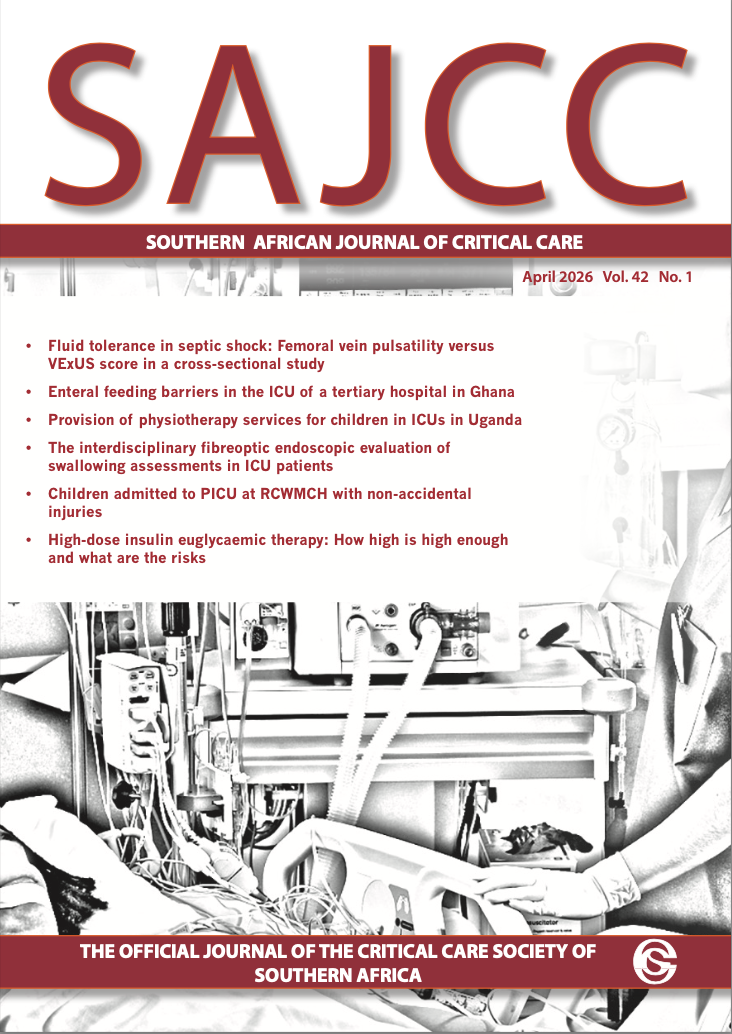
The interdisciplinary fibreoptic endoscopic evaluation of swallowing assessments in ICU patients: A file review
Article Sidebar
Main Article Content
Abstract
Background. Dysphagia is a complex condition common in critical care settings, often resulting from multifactorial causes such as trauma, neuromuscular weakness, impaired cognition, intubation and the presence of a tracheostomy. Dysphagia can have serious consequences, including aspiration pneumonia and prolonged hospital stays, which need to be avoided in resource-constrained environments such as South Africa (SA).
Objective. To investigate the characteristics of dysphagia in critically ill patients using an interdisciplinary assessment approach that utilises both bedside evaluations and fibreoptic endoscopic evaluation of swallowing (FEES).
Methods. A retrospective file review was conducted of 68 adult patients who underwent interdisciplinary dysphagia assessments in a private SA hospital between July 2022 and January 2024. Data collected included clinical notes, anatomical and physiological markers, Penetration-Aspiration Scale (PAS) scores and post-assessment diagnoses. Descriptive statistics were employed to analyse variables such as age, gender, comorbidities and dysphagia symptoms.
Results. The mean age of participants was 59.5 years (standard deviation (SD) 17.05 years), with the majority presenting with trauma-related injuries or cerebrovascular accidents. Dysphagia was prevalent, with 49% of patients exhibiting significant swallowing difficulties. The mean PAS score was 3.44 (SD 2.82), indicating that material often entered the airway without being ejected. Notably, 17% of patients presented with silent aspiration, highlighting the need for comprehensive interdisciplinary assessment techniques. Common symptoms included pooling, dysphonia and delayed swallow triggers, which may be identified at the bedside and confirmed using FEES. Patients were referred to speech-language therapy (SLT) after a median of 13 days in the intensive care unit (ICU).
Conclusion. Dysphagia is a significant concern in critical care, necessitating early and co-ordinated assessment strategies to minimise complications and improve patient outcomes. This study advocates enhanced protocols and interdisciplinary collaboration to manage dysphagia effectively. Early referral to SLT is critical for timely intervention, which is essential in an under-resourced setting. Future research across various settings is needed to further validate the interdisciplinary model of dysphagia assessment and management and to generate additional local data on dysphagia in the ICU.
Article Details
Issue
Section

This work is licensed under a Creative Commons Attribution-NonCommercial 4.0 International License.
Authors retain copyright and grant the journal right of first publication.
How to Cite
References
1. Mayerl CJ, Gould FDH, Adjerid K, Edmonds C, German RZ. The pathway from anatomy and physiology to diagnosis: A developmental perspective on swallowing and dysphagia. Dysphagia 2023;38:33-41. https://doi.org/10.1007/s00455-022-10449-x
2. Likar R, Aroyo I, Bangert K, et al. Management of swallowing disorders in ICU patients – A multinational expert opinion. J Crit Care 2024;79:154447. https://doi.org/10.1016/j. jcrc.2023.154447
3. Brodsky MB, Pandian V, Needham DM. Post-extubation dysphagia: A problem needing multidisciplinary efforts. Intensive Care Med 2020;46:93-96. https://doi.org/10.1007/s00134- 019-05865-x
4. Brodsky MB, Nollet JL, Spronk PE, González-Fernández M. Prevalence, pathophysiology, diagnostic modalities, and treatment options for dysphagia in critically ill patients. Am J Phys Med Rehabil 2020;99(12):1164-1170. https://doi.org/10.1097/phm.0000000000001440
5. Macht M, Wimbish T, Bodine C, Moss M. ICU-acquired swallowing disorders. Crit Care Med 2013;41(10):2396-2405. https://doi.org/10.1097/ccm.0b013e31829caf33
6. Perren A, Zürcher P, Schefold JC. Clinical approaches to assess post-extubation dysphagia (PED) in the critically ill. Dysphagia 2019;34(4):475-486. https://doi.org/10.1007/s00455-019-09977-w
7. Schröder J, Glahn J, Dziewas R. ICU-related dysphagia: Epidemiology, pathophysiology,
diagnostics, and treatment. ICU Management 2015;15(3):108-111.
8. Zuercher P, Moret CS, Dziewas R, Schefold JC. Dysphagia in the intensive care unit: Epidemiology,
mechanisms, and clinical management. Crit Care 2019;23:103. https://doi.org/10.1186/s13054-
019-2400-2
9. Spronk PE, Spronk LEJ, Egerod I, et al. Dysphagia in intensive care evaluation (DICE): An international cross-sectional survey. Dysphagia 2022;37(6):1451-1460. https://doi.org/10.1007/ s00455-021-10389-y
10. Wallace S, McGrath BA. Laryngeal complications after tracheal intubation and tracheostomy. BJA Educ 2021;21(7):250-257. https://doi.org/10.1016/j.bjae.2021.02.005
11. Wilkinson JM, Codipilly DC, Wilfahrt RP. Dysphagia: Evaluation and collaborative management. Am Fam Physician 2021;103(2):97-106. PMID: 33448766
12. Moss M, White SD, Warner H, et al. Development of an accurate bedside swallowing evaluation decision tree algorithm for detecting aspiration in acute respiratory failure survivors. Chest 2020;158(5):1923-1933. https://doi.org/10.1016/j.chest.2020.07.051
13. Langmore SE, Scarborough DR, Kelchner LN, et al. Tutorial on clinical practice for use of the fiberoptic endoscopic evaluation of swallowing procedure with adult populations: Part 1. Am J Speech Lang Pathol 2022;31(1):163-187. https://doi.org/10.1044/2021_ajslp-20-00348
14. Curtis JA, Borders JC, Perry SE, Dakin AE, Seikaly ZN, Troche MS. Visual analysis of swallowing efficiency and safety (VASES): A standardized approach to rating pharyngeal residue, penetration, and aspiration during FEES. Dysphagia 2022;37(2):417-435. https://doi.org/10.1007/s00455-021- 10293-5
15. Sheppard V. Research Methods for the Social Sciences: An introduction. British Columbia, CA: BCcampus, 2020. https://pressbooks.bccampus.ca/jibcresearchmethods/
16. Howell DC. (2020). Fundamental Statistics for the Behavioral Sciences. 9th ed. Belmont, CA: Cengage Learning, 2020.
17. Pillay-van Wyk V, Msemburi W, Laubscher R, et al. Mortality trends and differentials in South Africa from 1997 to 2012: Second National Burden of Disease study. Lancet Glob Health 2016;4(9):e642-e653. https://doi.org/10.1016/S2214-109X(16)30113-9
18. Leder SB, Warner HL, Suiter DM, et al. Evaluation of swallow function post-extubation: Is it necessary to wait 24 hours? Ann Otol Rhinol Laryngol 2019;128(7):619-624. https://doi. org/10.1177/0003489419836115
19. McRae J, Montgomery E, Garstang Z, Cleary E. The role of speech and language therapists in the intensive care unit. J Intensive Care Soc 2020;21(4):344-348. https://doi. org/10.1177/1751143719875687
20. Langmore SE. Evaluation of oropharyngeal dysphagia: Which diagnostic tool is superior? Curr Opin Otolaryngol Head Neck Surg 2003;11(6):485-489. https://doi.org/10.1097/00020840- 200312000-00014
21. Buxton PS. The retrospective record review: A methodological option for educational research. J Res Educ 2020;30(2):17-34.
22. Kamper SJ. Generalizability: Linking evidence to practice. J Orthop Sports Phys Ther 2020;50(1):45-46. https://doi.org/10.2519/jospt.2020.0701